
Basic concepts and features of Smart Communications
Customer Profile
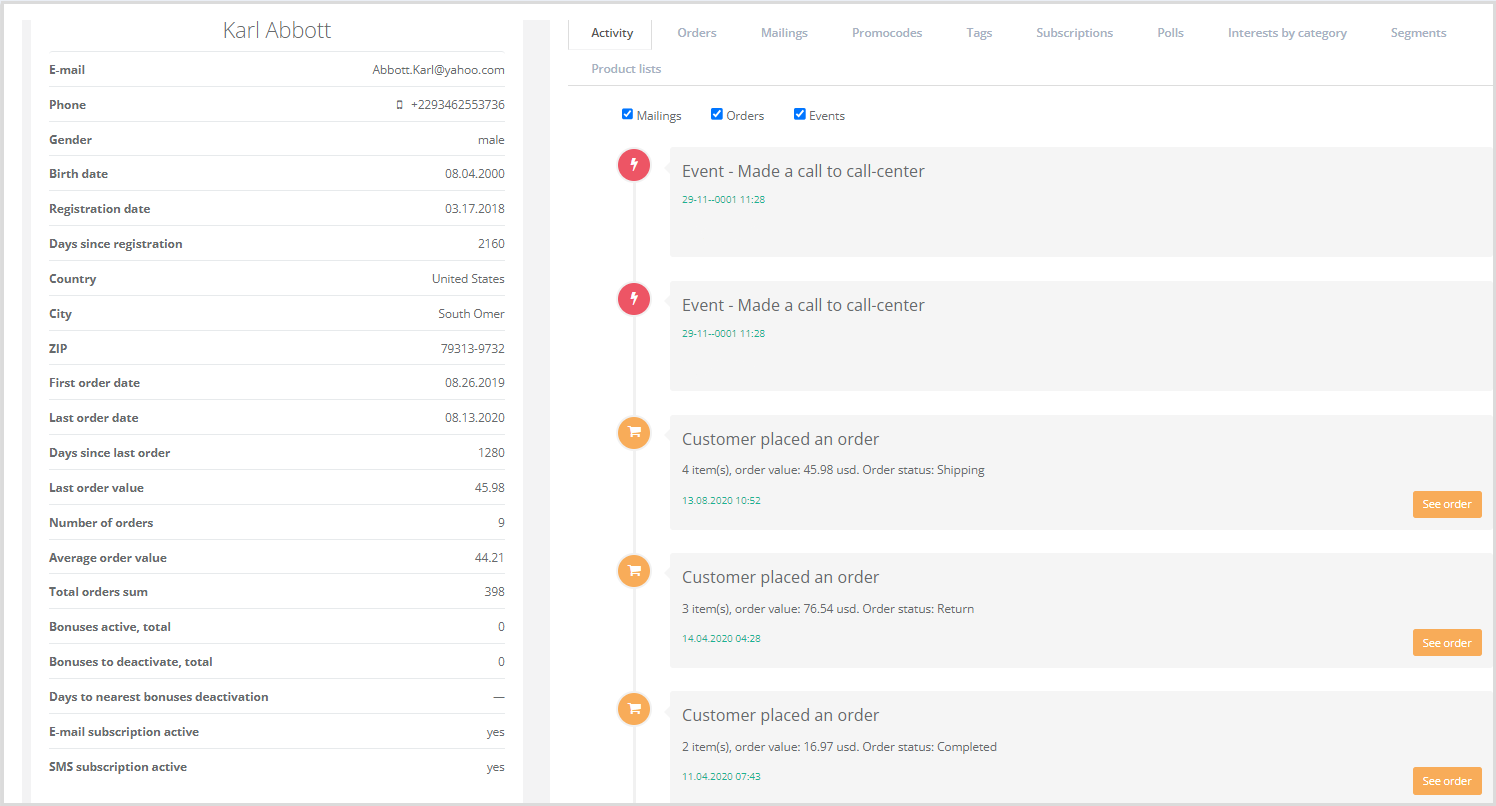
Comprehensive customer information containing:
- Customer attributes (for example — name, phone number, gender, city, external metrics);
- Customer's transaction data (purchase history or service order history);
- Customer-related events (reaching out to the call center, website visits, etc.);
- Metrics generated in the System (number of orders, average customer basket, last order date, RFM segment, and more).
|
Customer base capabilities:
- Creating customer 360 profile:
- all known customer details;
- values of customer metrics;
- customer transactions;
- customer-related events;
- history of mass messagings related to the customer, assignment of metrics, accrual of bonus points;
- website visit history;
- customer impact and their response actions.
- Automatic tagging of customers based on rules;
- Automatic accrual of bonus points based on rules (for example, for certain actions);
- Attributing assisted customer transactions (online/offline) to specific communication chains and mass mailings;
- Automatic data quality improvement: standardizing phone numbers and emails, identification of time zone and operator by phone number and email;
- Calculation and visualization of customer interests based on the history of website visits.
Segment
A segment is a set of customers united by a common feature or a set of features. Segmentation features and sampling capabilities include:
- Visual sampling editor;
- Samples by customer properties, customer transaction properties, transaction composition;
- Samples by tags, grades, calculated metrics (AOV, CLTV, RFM, etc.), bonus points;
- Samples based on the customer interests and history of website visits;
- Samples by customer events;
- Samples based on survey results;
- Samples based on customer communication history and customer response to communication;
- Saved segments;
- Support for customer source / transaction source;
- Support for user fields in customer profiles, transactions, transaction lines.
Examples of segments: one-time buyers, regular buyers, residents of Houston, dental powder buyers over 30 years old.
The System stores the rules for selecting customer profiles and current values of metrics such as the number of profiles, average check, LTV, etc. for each segment.
Segments are recalculated several times a day.
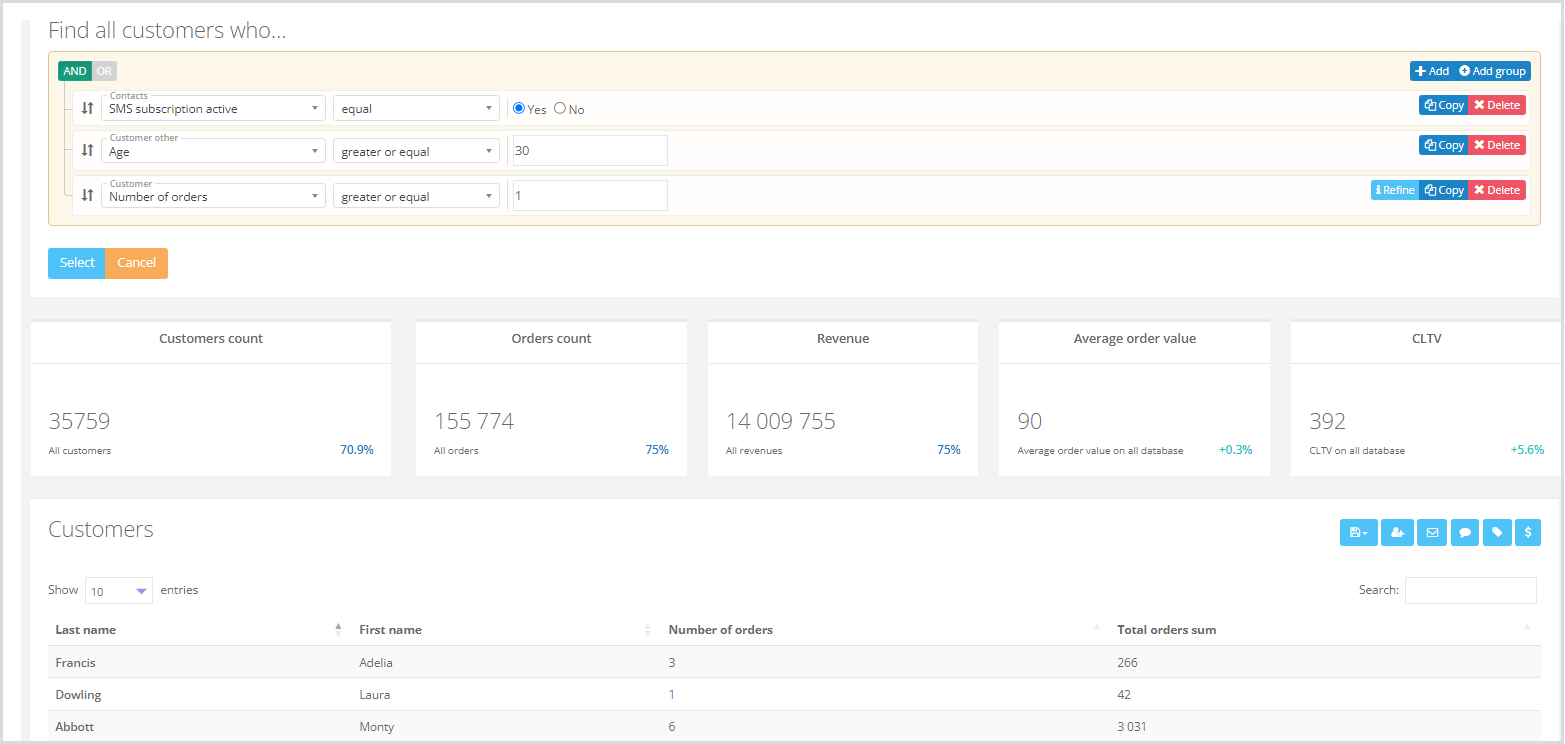
Example of sampling rules:
- Contacts. SMS subscription is active: yes;
- Customer. Number of orders: more than or equal to 1;
- Customer. Age: more than or equal to 30.
A list of buyers over 30 years old who have made at least one purchase and receive SMS notifications will be formed based on these rules.
|
Tags
Tagging allows to create a named list of customers.
For example, you can select all customers who bought a laptop in 2019 and tag them as "Laptop 2019".
Read more about how to set a tag in a separate article.
Mass mailing
Mass mailing is a onetime task for the System to select the customer profiles from a segment and send them a preset message. The following channels are available for mass mailings: email, SMS/Viber, push notifications.
Campaign
Campaigns are communication chains that describe the rules of the System interaction with customers. Campaigns are automatically executed by the System at a specified frequency.
Capabilities of communication chains and mass mailings:
- Automated communication chains and manual mass mailings;
- Visual editor of communication chains;
- Unlimited length, number of conditions and branches in communication chains;
- Over 20 types of adjustable triggers launching the chains, including arbitrary customer and system-wide external events, abandoned carts, and other website events;
- Managing the criteria for customer re-entry into the communication chain;
- Visual message editor;
- Message preview on devices of different size: PC, tablet, phone;
- Text templates;
- Templates import;
- Quick assembly of text messages from templates;
- Advanced template engine with support for conditions and cycles;
- Variables: any attributes from the customer profile and from customer-related objects (orders, events) can be added to the message;
- Option for the recipient to unsubscribe.
- Personalization based on the history of website visits (viewed product categories, viewed products, abandoned carts);
- Visualization of communication chains and mass messagings in the calendar;
- Sending emails and delivery analytics;
- Sending emails via an external provider or via Loymax Smart Communications delivery infrastructure (up to 18 million emails per day);
- Sending SMS and the respective analytics;
- Sending push notifications and the respective analytics;
- Analysis of delivery errors, server responses and spam filters of email service providers — marking incorrect email addresses and phone numbers;
- A/B tests of communication chains;
- A/B-tests of mass mailings;
- Sending test messages;
- Accounting for the recipient's time zone when sending text messages.
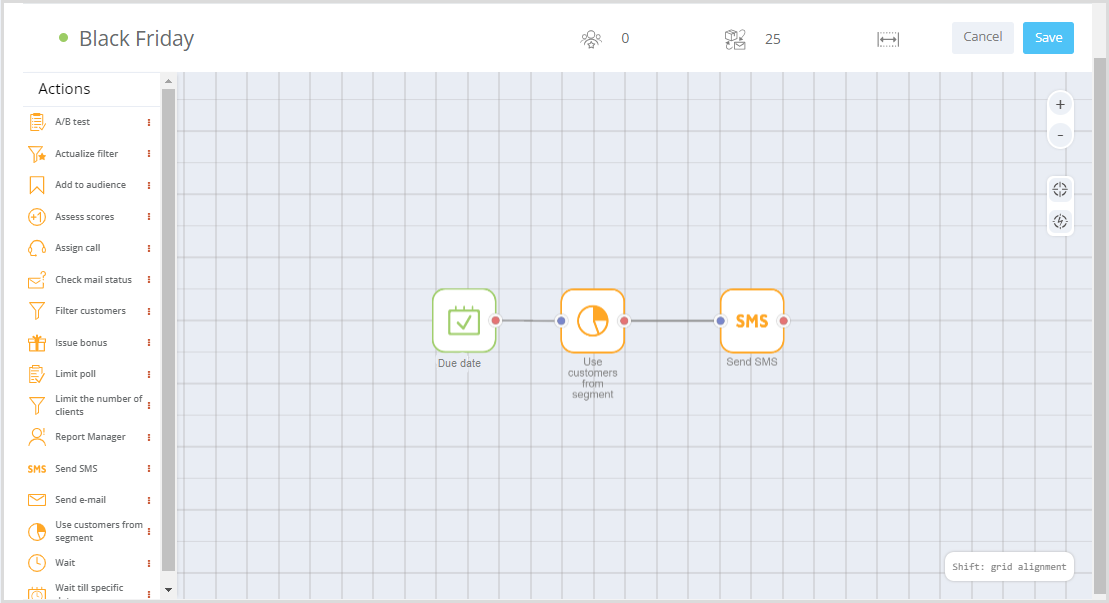
Campaign example:
- Black Friday date: November 24, 2023;
- Select customers from the segment: regular customers;
- Send SMS message.
As part of this campaign, all customers who fall within the Regular Customers segment will receive an SMS message 24 hours before Black Friday.
|
Analytics
Smart Communications provides the ability to monitor and analyze processes. The data obtained is used to generate reports and make further decisions regarding customer management.
Analytical capabilities:
- Standard reports on the customer base.
- Summary reports for each communication channel, trigger chain summary report.
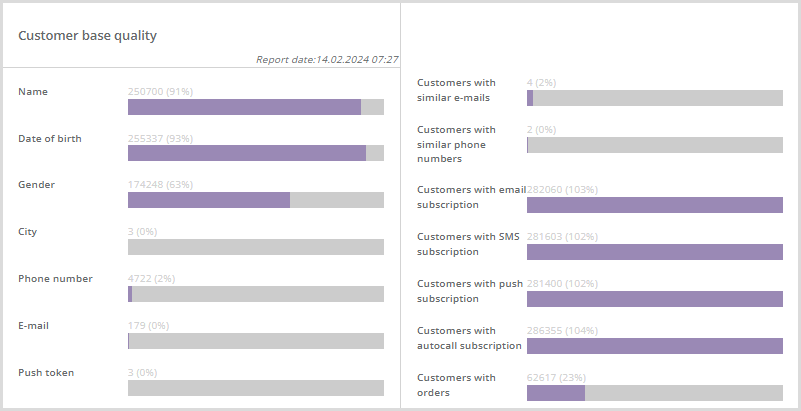
- Trend and current snapshot of customer base quality metrics.
- Trend and current snapshot of message delivery for mass messagings and communication chains.
- Trend and current snapshot of conversion funnel for mass messagings and communication chains.
- Efficiency of mailings and communication chains — trend of assisted transactions in relation to specific mass messagings and communication chains (campaigns).
- Attributing customer purchases to communication chains and mass messagings that initiated those purchases.
- Report on emails open rate by time of day and week days.
- Email delivery report.
- Visualization of RFM segments.
- Contact data quality report.
Sample report Customer base quality:
 |
Integration
Smart Communications supports a wide range of integration capabilities:
- Data import/export to/from other information systems.
- Data exchange with external systems via REST API.
- JavaScript tracker for analyzing customer behavior on a web site.
- Communication channel integrations (email, SMS, push, in-app, chat bots, voice assistants, and others).
For more information about integration capabilities, see Integration